Everything You need to Know about ASTM B983
Overview
ASTM B983 is a specific standard for nickel alloy pipes. It primarily specifies the requirements for high-strength nickel alloy materials, including chemical composition, mechanical properties, dimensions, and heat treatment methods. This article will detail the various aspects of ASTM B983 to provide you with a clearer reference when making purchases.
Grades & Chemical Composition
Grades
Materials in ASTM B983 are generally of relatively high strength. Among them are materials like Inconel 718 and Inconel 725, whose strength can be increased through precipitation hardening, and materials like Hastelloy G-3 and Hastelloy C-276, which can achieve high strength through cold working. For the latter, if you require a softer, annealed material, you should refer to ASTM B622.
Chemical Composition
Inconel 718(UNS N07718)
718
Si
C
Al
Ti
Co
Nb
Ta
Mo
Fe
Cr
Ni
Inconel 725(UNS N07725)
725
Si
Al
Ti
Nb
Mo
Fe
Cr
Ni
Inconel 740H(UNS N07740)
740H
Si
Mn
Al
Ti
Cu
Co
Mo
Fe
Cr
Ni
Incoloy 925(UNS N09925)
925
Si
Mn
Al
Ti
Cu
Nb
Mo
Fe
Cr
Ni
Incoloy 945(UNS N09945)
945
Si
Mn
Al
Ti
Cu
Nb
Mo
Fe
Cr
Ni
Hastelloy C-22HS(UNS N07022)
C-22HS
Al
Cu
Co
W
Fe
Mo
Cr
Ni
Hastelloy C-276(UNS N10276)
C-276
Mn
Co
V
W
Fe
Mo
Cr
Ni
Hastelloy G-3(UNS N06985)
G-3
Si
Mn
Cu
Co
W
Fe
Mo
Cr
Ni
ASTM B983 specifies the chemical composition of various high-strength materials. For precipitation-strengthened alloys like Inconel 718, the key elements are aluminum, titanium, niobium, and tantalum. These elements contribute to the alloy's high strength through precipitation strengthening. For solid-solution-strengthened alloys like Hastelloy C-276, molybdenum and tungsten are more important, as they enhance the alloy's strength after cold working through solid solution treatment.
Product Properties
Products in ASTM B983
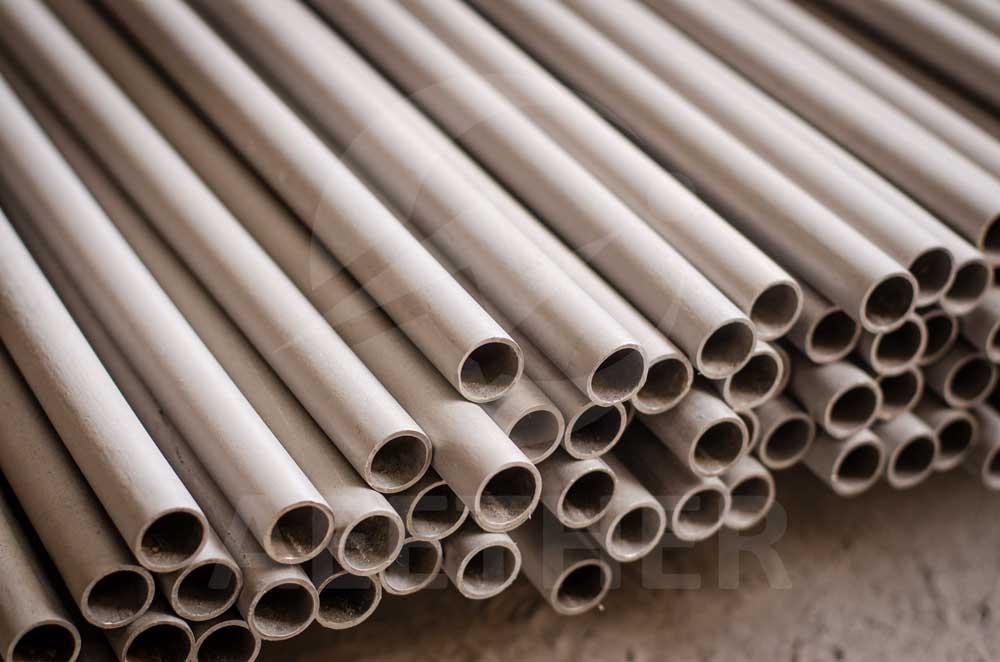

ASTM B983 applies to seamless tubing. Seamless tubing is produced by cold rolling a round bar after piercing. This type of tubing has better pressure resistance. Furthermore, the high-strength materials in ASTM B983 further enhance this pressure resistance, allowing the tubing to be used normally in more extreme environments.
Mechanical Properties
ASTM B983 specifies the mechanical properties of various materials. It is evident that their tensile strength and yield strength are significantly higher than those of typical nickel alloys. Furthermore, precipitation-strengthened alloys also exhibit higher strength than cold-worked solution-strengthened alloys.
| Alloy | Condition | Tensile Strength, min., ksi (MPa) |
Yield Strength min., ksi (MPa) |
Elongation in 2 in., (50 mm) or 4D B , min, % |
Hardness Rc max |
|
|---|---|---|---|---|---|---|
| UNS N07022 Type 1A | Solution Ann + cw | 160 (1103) | 150 (1034) | 17 | 42 | |
| UNS N07022 Type 1B | Solution Ann + cw | 185 (1276) | 180 (1240) | 13 | 46 | |
| UNS N07022 Type 2 | Solution Ann + cw | + prec hard | 178 (1227) | 160 (1103) | 15 | 50 |
| UNS N07725 Type 1 | Solution Ann + prec hard | 150 (1035) | 120 (827) | 20 | 43 | |
| UNS N07725 Type 2 | Solution Ann + cw | + prec hard | 150 (1035) | 120 (827) | 20 | ... |
| UNS N07740 | Solution Ann + prec hard | 150 (1035) | 90 (620) | 20 | ... | |
| UNS N09945 Type 1 | Solution Ann + prec hard | 150 (1035) | 130 (896) | 18 | 42 | |
| UNS N09945 Type 2 | Solution Ann + prec hard | 165 (1138) | 140 (965) | 18 | 42 | |
| UNS N09925 | Solution Ann + prec hard | 140 (965) | 110 (758) | 18 | 38 | |
| UNS N07718 | Solution Ann + prec hard | 150 (1034) | 125 (862) | 20 | 40 | |
| UNS N10276 Type 1 | Solution Ann + cw | 115 (793) | 110 (758) | 11 | 40 | |
| UNS N10276 Type 2 | Solution Ann + cw | 130 (896) | 125 (862) | 10 | 40 | |
| UNS N06985 Type 1 | Solution Ann + cw | 115 (793) | 110 (758) | 11 | 40 | |
| UNS N06985 Type 2 | Solution Ann + cw | 130 (896) | 125 (862) | 10 | 40 |
Delivery State
The delivery state specified in ASTM B983 is particularly noteworthy. In most precipitation-strengthened alloy standards (such as ASTM B637 and ASTM B670), the alloy is required to be delivered in solution-treated form, with the customer performing further processing upon receipt, followed by aging treatment. However, ASTM B983 requires the material to be delivered in its highest strength condition. This is primarily because seamless pipes generally do not undergo further processing.
Another point to note is that even the same material may correspond to different delivery conditions in the standard. For example, Inconel 725 can be delivered either in a solution-treated + aging-treated condition or in a solution-treated + cold-worked + aging-treated condition. The latter will result in higher hardness. Therefore, even for the same material, the specific condition must be determined before production.
Other Information
Heat Treatment
ASTM B983 specifies heat treatment methods for different materials, including temperature, holding time, and cooling rate. Precipitation-strengthened alloys require two heat treatments: solution treatment and aging treatment.
| Alloy | Recommended Solution Annealing Treatment |
Recommended Precipitation Hardening Treatment |
|---|---|---|
| UNS N07022 Type 1A or 1B | 1800–2100°F (982–1149°C), hold 1/2 hr/in., 5 min. minimum, rapid air cool or water quench |
none |
| UNS N07022 Type 2 | 1800–2100°F (982–1149°C), hold 1/2 hr/in., 5 min. minimum, rapid air cool or water quench |
1075–1150°F (579–621°C), hold 10 h, air cool |
| UNS N07725 Type 1 | 1900 ± 25°F (1040 ± 14°C), hold 1 h per in. of thickness, water quench or rapid air/gas cool |
1350 ± 25°F (730 ± 14°C), hold 8 h, furnace cool at 100°F (56°C) per min. to 1150 ± 25°F (620 ± 14°C), hold for 8 h, air cool |
| UNS N07725 Type 2 | 1900 ± 25°F (1040 ± 14°C), hold 1 h per in. of thickness, water quench or rapid air/gas cool |
1350 ± 25°F (730 ± 14°C), hold 8 h, furnace cool at 100°F (56°C) per min. to 1150 ± 25°F (620 ± 14°C), hold for 8 h, air cool |
| UNS N07740 | 2050 ± 25°F (1120 ± 14°C), hold 1/2 h., water quench |
1472 ± 25°F (800 ± 14°C), hold 4 to 16 h, air cool |
| UNS N09945 Type 1 | 1850–1950°F (1010–1066°C) hold 0.5 to 4 h, water quench |
1300–1350°F (704–732°C), for 6 to 8 h, furnace cool at 50–100°F (26–56°C)/h to 1125–1175°F (607–635°C) hold 6 to 8 h, air cool |
| UNS N09945 Type 2 | 1850–1950°F (1010–1066°C) hold 0.5 to 4 h, water quench |
1300–1350°F (704–732°C), for 6 to 8 h, furnace cool at 50–100°F (26–56°C)/h to 1125–1175°F (607–635°C) hold 6 to 8 h, air cool |
| UNS N09925 Batch Anneal | 1825–1875°F (996–1024°C) hold 0.5 to 4 h, air cool or faster |
1365–15°F (740–9°C) hold 6 to 9 h, furnace cool to 1150°F (621°C) for total aging time of 18 min., air cool |
| UNS N07718 | 1875 ± 25°F (1024 ± 14°C) for 1 to 2 h, water quench |
1425–1475°F (774–802°C) hold 6 to 8 h, air cool |
| UNS N10276 | 2050°F (1121°C) minimum for time commensurate with thickness |
none |
| UNS N06985 | 2050°F (1121°C) minimum for time commensurate with thickness |
none |
Dimension
ASTM B983 also specifies dimensional tolerances for hot-worked materials. For conventional cold-worked materials, tolerances should refer to ASTM B829.
| Nominal Outside Diameter, in. (mm) |
Outside Diameter, in. (mm) |
Permissible Variations, % of Thickness of Specified Nominal Wall |
% of Thickness of Specified Minimal Wall |
|||
|---|---|---|---|---|---|---|
| Plus | Minus | Plus | Minus | Plus | Minus | |
| 3/4 (19) to 1-1/2 (38), incl | 0.015 (0.4) | 0.031 (0.8) | 12.5 | 12.5 | 28.5 | 0 |
| Over 1-1/2 (38.1) to 4 (102), incl | 0.031 (0.8) | 0.031 (0.8) | 12.5 | 12.5 | 28.5 | 0 |
| Over 4 (102) to 9-1⁄4 (235), incl | 0.062 (1.6) | 0.031 (0.8) | 12.5 | 12.5 | 28.5 | 0 |
| Over 9-1⁄4 (235) to 12 (305), incl | 0.110 (2.8) | 0.110 (2.8) | 12.5 | 12.5 | ... | ... |
| Nominal Outside Diameter, in. (mm) |
Outside Diameter, in. (mm) |
Permissible Variations, % of Thickness of Specified Nominal Wall |
% of Thickness of Specified Minimal Wall |
|||
|---|---|---|---|---|---|---|
| Plus | Minus | Plus | Minus | Plus | Minus | |
| 1 (25) to 1.900 (48), incl | 0.015 (0.40) | 0.031 (0.79) | 16.0 | 12.5 | 28.5 | 0 |
| Over 1.900 (48) to 4-1/2 (114), incl | 0.031 (0.79) | 0.031 (0.79) | 16.0 | 12.5 | 28.5 | 0 |
| Over 4-1/2 (114) to 6-1/2 (165), incl | 0.047 (1.2) | 0.047 (1.2) | 16.0 | 12.5 | 28.5 | 0 |
| Over 6-1/2 (165) to 9-1⁄4 (235), incl | 0.062 (1.6) | 0.062 (1.6) | 16.0 | 12.5 | 28.5 | 0 |
| Over 9-1⁄4 (235) to 14 (356), incl | 0.120 (30.5) | 0.120 (3.05) | 16.0 | 12.5 | ... | ... |
| Over 14 (356) to 24 (610), incl | 0.20 (5.08) | 0.20 (5.08) | 16.0 | 12.5 | ... | ... |
Non-Destructive Testing
Materials in ASTM B983 must undergo non-destructive testing. For seamless pipes, hydrostatic testing and eddy current testing are common methods. If hydrostatic testing is performed, the pressure value (1000 psi) required by the standard must be met.
Certification
To prove that the material conforms to the standard, the supplier should provide a material testing certificate before shipment. The certificate should specify the requirements mentioned in the standard, including but not limited to dimensions, quantity, heat number, chemical composition, mechanical properties, and non-destructive testing.
Conclusion
ASTM B983 mainly covers precipitation-strengthened alloy seamless tubes such as Inconel 718, Inconel 725, and Incoloy 925, as well as cold-worked alloy seamless tubes such as Hastelloy G-3 and Hastelloy C-276. They all share the characteristic of high strength. The standard specifies multiple requirements, including chemical composition, mechanical properties, and heat treatment methods.
We strictly produce the corresponding materials according to ASTM B983 and customize the delivery condition of the materials according to customer requirements. Please contact us if you have any needs: